
This is a very common question we hear a lot. The concerns about Google’s changing AI algorithm and other changing factors. Whether Google Ads will be worth it for your business depends on your business’s industry, budget, goals, and how you plan on managing ads.
We have made incredible success stories and heard ridiculous spending horror stories from businesses about Google Ads, so here we’ll break down whether Google Ads are worth it.
If you want to know more about how Google Ads work and what they are, you may be interested in some of our other blog posts…
First, let’s address some common concerns about whether Google Ads even work.
Do Google Ads Work
Some businesses may question if Google Ads Even work and are effective. We’ve heard the sentiment of business owners dealing with spam calls, maxing daily budgets, and inflated cost-per-click.

We’ve also seen people have incredible success rates and high returns on investment. So what’s going on?
Well, let’s make it clear, yes, Google Ads do work, with stipulations. You have to do them right and correctly configure your ad campaign to get the right high-quality leads.
Google Ads can be a very powerful tool when properly leveraged, but without the right strategy, the money can be wasted.
Assuming a proper approach, they have some serious upsides to using Google Ads, so let’s evaluate the pros of Google Ads…
Pros of Google Ads
Here are some of the pros of Google Ads and why they are worth doing for your small business. It’s important to know the visible and less visible impact of ads on your business. We’ll go over that and more here:
Pros at a glance:
- Google is the most used search engine
- High average Return on Investment (ROI)
- Targeted Google Ads
- Large variety of format options
- Google Analytics and performance tracking
- Much faster than Search Engine Optimization (SEO) alone
- Getting to the top of the Search Engine Results Page (SERP)
- Spending control and flexibility
- Local and niche ad targeting
Google is the Most Used Search Engine
Even now in 2026, Google has over 90% the Worldwide Search Engine Market Share, according to GlobalStats. This means that virtually any demographic that’s searching online are potential customer. Google ads will have the largest reach of any search engine.
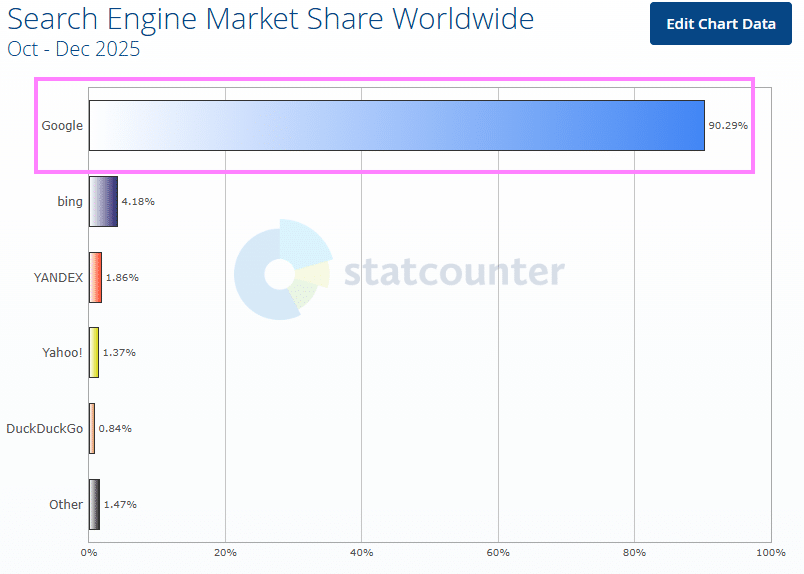
Image Credit: https://gs.statcounter.com/search-engine-market-share#monthly-202510-202512-bar
High Average Return on Investment (ROI)
According to Google’s Economic Impact Analysis, on average, businesses can expect to receive $2 of revenue for every $1 spent on Google Ads.
However, when factoring in search clicks, they estimate that every $1 spent on Google Ads outputs $8 of profit due to Google Search and Google Ads.
While Google says to expect an 800% return on investment, this is only the return of Google Ads and assumes your product can be successfully marketed using Google Ads.
Targeted Google Ads
Google uses its tracking analytics to target Google Ads to consumers who are most likely to engage with the advertisement.
Google Ads uses intent to market your product directly to consumers who have actual purchase intent.
This filters people unlikely to buy or who don’t have the intent to engage with the advertisement.
Large Range of Google Ads Formats
There are lots of different goals that can be met through using Google Ads. Google uses Ad Campaigns to determine the types of ads to run, as well as how and where to target the ads.
Check out our blog on the different types of Google Ad Campaigns!
These formats vary from search ads to text ads, display and video ads, etc. You can even include Google Maps ads to feature your business locally.
Google Analytics and Performance Tracking
Google has advanced free tools for Google Ads analytics. When using the Google Ads Manager, you can monitor the Pay Per Click (PPC) stats and performance tracking.
Syncing a Google Ads account to Google Analytics allows businesses to also analyze their cost per conversion (CPC) and click-through rate (CTR).
Much Faster Than Search Engine Optimization (SEO) Alone
Other traffic options, like SEO, require time and constant revision. While Google Ads have their own drawbacks and difficulties, once you have them setup they can instantly get traffic. Especially if your website already has strong SEO.
PPC has more instantaneous conversion, while SEO is important for the long term health of a website.
Getting to the Top of the SERP
SEO typically determines ranking for the search engine results page; however, search ads push websites based on a bid and quality score to the top.
For an explanation of how Google Ads Work, you may benefit from our blog.
So even if a website isn’t the first option for a search result, it can outbid its competitors to be at the top, and increase the likelihood of traffic or conversion.
Spending Control and Flexibility
Because of the way Google Ads and bidding work, businesses can set how much they’re willing to spend per click, as well as set a daily budget.
Since everything is controlled through Google, it is easy to adjust bids and spending limits as needed and on the fly.
Focus on Local or Niche Markets
Even physical location stores that are trying to attract physical traffic to their location can use Google Ads to target locally and to their niche audience.
Especially if your business has its own niche, it is very easy to place cheap bids targeting based on location, language, demographics, etc.
Next, let’s talk about the possible cons of Google Ads.
Cons of Google Ads
There are a few important downsides to Google Ads for a small business, some of which are mainly industry-dependent
Cons at a glance:
- Difficult to learn
- Require an optimized landing page for quality results
- Industry-dependent: potentially high minimum investment
- Time-Consuming
Difficult to Learn
Google Ads aren’t necessarily beginner-friendly. It’s a tool like anything else, so navigating the learning curve can be complex — aspects such as understanding bidding and which specific keywords to target for the best outcome.

Without the right keyword management, a business can waste a lot of time and money.
Knowing how to appropriately use the analytics tools, how to choose keywords, and adjusting as Google makes changes are all important and constant pieces of the puzzle to make Google Ads work.
There are lots of things to keep track of that might need constant updating, such as keyword matching, bids, and website quality score.
Require an Optimized Landing Page for Quality Results
The most effective ads require optimized landing pages to get a good quality score.
Without a good quality score, ads require higher bidding to get seen, and without that, your ads won’t be seen at all.
Industry-Dependent: Potentially High Minimum Investment
One of the biggest hurdles for small businesses is the initial investment. Unfortunately, some industries just have higher competition than others, which raises the minimum price of bids.
Some examples of these types of industries are: law, Finance, Insurance, Real Estate, and some Home services. Any industry with a high Cost Per Acquisition will have a high CPC for Google Ads.
Despite high investment cost, Google Ads will still be beneficial and profitable due to the high return from those leads if a business is willing to put down the money.
So, on a tight budget in a competitive business, Google Ads might be too pricey when dealing with large keywords. However, there are still ways to offset this downside.
Time-Consuming
There is constant upkeep and attention required for effective Google Ad campaigns. Oftentimes, keywords will require adjustment to optimize targeting.
Constant maintenance and attention such as this is imperative for a successful Google Ads campaign; this is time that business owners often don’t have.
Now that we know the pros and cons of Google Ads, let’s look at whether Google Ads are worth it for small businesses.
Are Google Ads Worth It for Small Businesses?
Overall, the short answer is yes, Google Ads are worth it for small businesses in most cases. Google Ads aren’t one size fits all, so there are many considerations when it comes to choosing if Google Ads are right for your business.
Especially when marketing to local customers with high intent to purchase, Google Ads are worth it since they can draw more people in.
Finally, let’s see how we can make Google Ads work for your business…
How Google Ads Can Work For Small Businesses
We know that taking the time to learn all of the ins and outs of Google Ads to get the most out of them is very time-consuming.
There’s a reason why Google Ads Managers exist; while it’s possible to set everything up yourself, there’s a much higher chance of running into some of the cons of Google Ads.
To avoid running into wasted time, money, effort, and energy, consider contacting us for a consultation if Google Ads would be profitable for your business.
Leave a Reply