
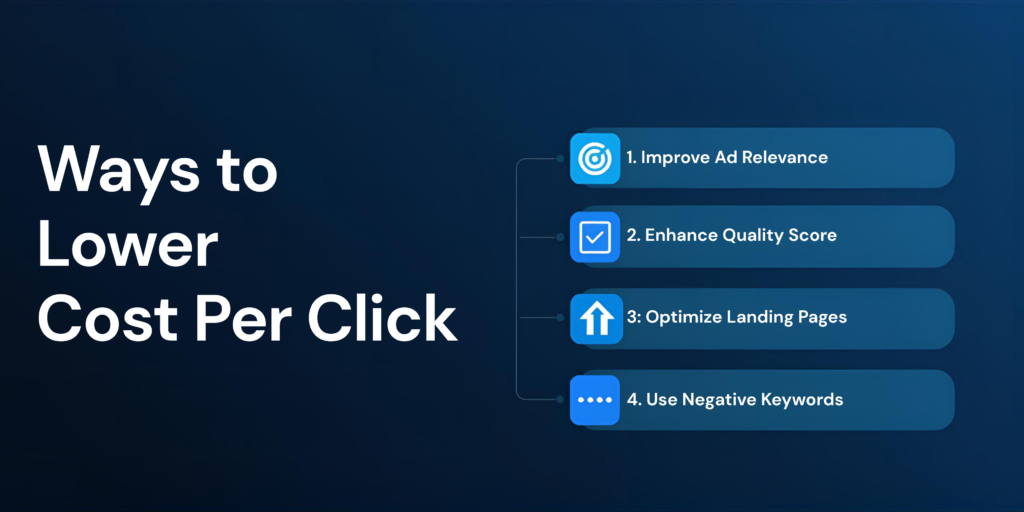
As a business owner, if you’re looking to improve your cost-per-click efficiency, this article is for you. Improving your cost per click can be very beneficial to your business and help you to take it to the next level.
In the next sections, we will go over some helpful tips on what to do and what to avoid in order to help your cost per click thrive.
Strategies to Lower Cost Per Click
Here are some cost-per-click optimization tips that you can apply to your Google Ads:
1. Select Quality Keywords, Avoid Just Using Cheapest
Striking a balance between cost and effectiveness is essential. Avoid focusing solely on low-cost keywords, as they may not always drive quality conversions.
Instead, opt for a mix of keywords that capture your audience’s intent and have good search volume. This will help improve your Quality Score and reduce your CPC over time.
2. Optimize Ads and Landing Pages for Higher Quality Scores
Google rewards ads with high Quality Scores by offering lower CPCs. Ways to improve Quality Score include:
- Focus on making your ad copy more relevant.
- Enhancing the quality of your landing page.
Refresh your ads regularly, integrate relevant keywords, and ensure your landing page aligns with the promises made in your ads. A strong Quality Score means more clicks for less money.
3. Use Long-Tail Keywords to Narrow Targeting
Long-tail keywords are more specific and less competitive than broad terms. This reduces costs while improving relevance for your target audience.
While long-tail keywords may generate fewer clicks, they tend to attract leads of higher quality who are more likely to convert. This makes the strategy a more budget-friendly approach while maintaining high conversion potential.
4. Leverage Negative Keywords to Block Irrelevant Clicks
Negative keywords are essential for blocking irrelevant traffic that wastes your budget. This is similar to 3, acting as a way to further filter bad leads.
Regularly update your negative keyword list to filter out traffic that won’t convert, such as irrelevant products or geographic areas outside your target market.
5. Target Different Audience Segments
Customize your campaigns based on where the customer is in their journey. Prospective customers need different messaging than returning ones.
Using retargeting strategies to show tailored ads to visitors who’ve interacted with your brand before can help increase conversions and lower CPC.
6. Implement Ad Scheduling for Maximum Efficiency
Ad scheduling lets you show ads at optimal times when your audience is most active. Analyzing when your ads perform best enables you to adjust your schedule to focus on peak times, which will ultimately optimize your budget and lower your CPC.
7. Test Your Ads with A/B Variations
Constantly test different versions of your ads—such as headlines, images, and CTAs—to determine which elements perform best.
A/B testing can help refine your ads and ensure that every click you pay for is as cost-effective as possible.
8. Refine Your Geographic Targeting with Geotargeting
Use geotargeting to focus on regions with the highest demand for your product or service. This can help you avoid spending money on irrelevant clicks from areas outside your market.
9. Utilize Search Partner Networks for Cheaper Clicks
The Google Search Partner Network allows ads to appear on additional search-related websites, often at a lower CPC due to less competition.
Test this network by enabling it in your campaigns and see if it helps reduce your overall CPC.
10. Optimize for Mobile with Responsive Ads
With mobile search on the rise, optimizing your ads for mobile devices is essential. Responsive ads are more likely to attract relevant clicks from users browsing on smartphones, improving both your Quality Score and CPC.
Cost Per Click Strategies To Avoid
1. Avoid Bidding on Too Broad Keywords
Broad keywords might seem like a good way to reach a large audience, but they can result in irrelevant clicks that increase your CPC.
Instead, focus on keywords with clear user intent that directly relate to your product or service.
Narrowing your focus helps avoid paying for clicks that don’t convert.
2. Don’t Ignore Negative Keywords
If you don’t use negative keywords, you risk wasting money on clicks that aren’t relevant to your business. For example, if you’re selling premium products, you don’t want to attract people searching for cheap alternatives.
Always update and refine your negative keyword list to block irrelevant queries.
3. Avoid Overusing Generic, High-Competition Keywords
Generic keywords often come with a large amount of competition, which often will drive up your CPC. Relying solely on these terms will deplete your budget quickly without strong results.
Instead, combine them with long-tail keywords or less competitive phrases to better reach your target audience.
4. Don’t Overbid on High-Cost Keywords
Bidding too aggressively on high-cost keywords without considering your ROI can quickly eat into your ad budget. It’s important to evaluate whether the higher cost is justified by conversions.
Overbidding on expensive terms that don’t align with your business goals can lead to unnecessary expenses.
5. Avoid Using a Single Ad Group for Multiple Keywords
Grouping too many unrelated keywords into one ad group can harm your ad relevance and lower your Quality Score, which will ultimately increase your CPC.
Instead, create tightly themed ad groups that match specific keywords and have relevant ads for each group.
6. Don’t Forget to Optimize Landing Pages
If your landing page is generic or irrelevant to the ad, it can hurt your Quality Score and increase your CPC.
Make sure your landing page matches the content and intent of the ad to make a seamless experience for the user, which in turn will help improve conversion rates.
7. Avoid Ignoring Ad Extensions
Ad extensions can help boost your click-through rate (CTR) and increase visibility. Not using them means you’re missing out on extra, often free, space to provide more value to users.
These can help lower your CPC and improve ad performance.
8. Don’t Set and Forget Your Campaigns
Assuming your PPC campaigns will run smoothly without regular monitoring is a costly mistake.
Continuously review your campaigns, test different ad copies, analyze keyword performance, and adjust your strategy accordingly. You will miss opportunities to lower CPC and improve campaign effectiveness if you fail to make adjustments in your ad campaign.
9. Avoid Overcomplicating Audience Targeting
While audience targeting can be very powerful, getting too specific can limit your reach and increase CPC. Similarly, overly broad targeting can waste your budget.
Find a balance by testing different segments and optimizing based on performance.
10. Don’t Use Irrelevant Ad Copy
If your ad copy doesn’t align with what users are searching for, it can lower your Quality Score and increase your CPC.
Make sure your ad copy is clear, specific, and speaks directly to the user’s intent. Avoid vague or generic language, as it can hurt both CTR and conversion rates, leading to higher CPC.
How to Lower Cost Per Click Recap
Reading all that was probably a lot to take in, so we are going to highlight the dos and the don’ts of cost per click again for you.
| Do | Avoid |
| Select a mix of quality keywords, not just the cheapest | Bidding on too broad keywords |
| Optimize ads and landing pages for higher Quality Scores | Ignoring negative keywords |
| Use long-tail keywords for better targeting | Overusing generic, high-competition keywords |
| Leverage negative keywords to filter out irrelevant clicks | Overbidding on high-cost keywords without evaluating ROI |
| Target different audience segments | Using a single ad group for multiple, unrelated keywords |
| Implement ad scheduling for peak times | Forgetting to optimize landing pages |
| Test ads with A/B variations to improve performance | Ignoring ad extensions |
| Refine geographic targeting with geotargeting | Setting and forgetting campaigns without regular monitoring |
| Utilize Search Partner Networks for cheaper clicks | Overcomplicating audience targeting |
| Optimize ads for mobile with responsive formats | Using irrelevant or vague ad copy |
Remembering and implementing everything discussed in this article can be very difficult.
If you would like to save both time and money, you can contact MPire Marketing to have us do it right for you the first time.